
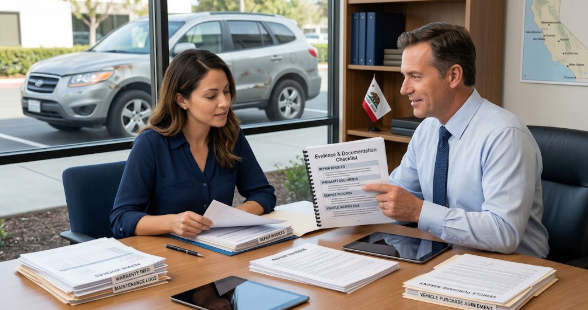
Maximizing a California lemon law settlement requires establishing clear, indisputable documentation long before filing a formal claim or hiring an attorney. Under the Song-Beverly Consumer Warranty Act (California Civil Code Section 1790 et seq.), the total recovery—whether through a full repurchase, vehicle replacement, or cash-and-keep settlement—depends directly on verifiable service records, consistent defect reporting, and precise calculation offsets. Early evidence collection prevents common manufacturer defense tactics that reduce payout values or delay resolution.
Understanding California’s Lemon Law Framework
The Song-Beverly Consumer Warranty Act protects consumers who purchase or lease new or used vehicles covered by an express manufacturer warranty. If an authorized dealership cannot repair a substantial defect after a “reasonable number” of attempts, the manufacturer must either replace the vehicle or refund its purchase price.
- Step 1: A recurring defect occurs while the vehicle is under express warranty.
- Step 2: You bring the vehicle to an authorized dealership for repair attempts.
- Step 3: The dealership generates precise service records and logs mileage.
- Step 4: The statutory mileage offset is calculated based on the first visit.
- Step 5: Pre-claim evidence is reviewed to evaluate overall claim strength.
- Step 6: The claim is presented to the manufacturer for buyback or resolution.
Statutory Presumptions vs. Legal Realities
California Civil Code Section 1793.22 establishes a legal presumption that a vehicle is a lemon if, within 18 months or 18,000 miles of delivery:
- The manufacturer has made 2 or more repair attempts for a defect likely to cause death or serious bodily injury.
- The manufacturer has made 4 or more repair attempts for the same general non-safety defect.
- The vehicle has been out of service for a cumulative total of more than 30 calendar days due to repairs.
Meeting these presumption thresholds shifts the legal burden to the manufacturer. However, a case can still qualify outside these windows as long as the initial defect was reported while the vehicle remained under the written manufacturer warranty.
Financial Components of a Buyback Settlement
A full California statutory buyback includes specific reimbursed expenses, minus a statutory usage offset:
- Down Payment and Monthly Payments: Full refund of all principal and interest payments made to date.
- Loan Payoff: Satisfaction of the remaining outstanding auto loan balance.
- Incidental Expenses: Reimbursement for towing fees, rental car costs, and repair bills.
- Statutory Usage Offset: A deduction based on the mileage driven before the first repair attempt for the defect.
Pre-Claim Strategy: Building Indisputable Evidence
The strength of a pre-claim file dictates whether a manufacturer settles quickly for full value or drags out negotiations.
1. Verification of the Service Repair Order
Every time a vehicle goes to an authorized dealership, two documents are produced: the initial Repair Order (RO) and the final Itemized Invoice. Manufacturers frequently use vague language written on these documents to dispute claims.
- Verbatim Complaint Entry: Ensure the service advisor writes down your exact description of the symptom (e.g., “transmission slips while accelerating at 45 mph”) rather than generic summaries like “check engine light on” or “customer states car runs rough”.
- Status “Cannot Duplicate”: If the dealership notes “Could Not Duplicate (CND),” demand that a technician perform a ride-along. Ensure the RO notes that you brought the vehicle in for that specific issue on that date, as unconfirmed visits still document notice to the manufacturer.
- In-and-Out Dates: Verify that the open date and close date match the exact calendar days the vehicle was physically located at the dealership to maximize cumulative out-of-service days.
2. Safeguarding Supporting Documentation
Relying solely on dealership databases is risky; dealership management systems update or purge records. Maintain independent digital and physical copies of:
- The original purchase agreement or lease contract (showing total sales price, trade-in value, and financing terms).
- All dealership repair orders, technician notes, and invoices.
- Payment receipts for out-of-pocket expenses (rental vehicles, ride-shares, towing).
- Audio, video, or photo evidence of intermittent electronic or mechanical failures that do not trigger permanent trouble codes.
The Statutory Mileage Offset: Protecting Settlement Value
The single largest deduction from a California Lemon Law repurchase calculation is the statutory mileage offset.
The Statutory Formula
California Civil Code Section 1793.2(d)(2)(C) defines the offset formula as:
Because the offset relies on the mileage at the first repair attempt for the subject defect, establishing that early mileage reading is critical.
Hypothetical Scenario: Impact of First Repair Attempt Documentation
Consider a consumer who purchases a new car for $45,000.
- Scenario A (First Repair Documented at 3,000 Miles):
- Calculation: (3,000 / 120,000) X $45,000
- Mileage Offset Deduction: $1,125$
- Consumer Retains: $43,875
- Scenario B (First Repair Delayed/Undocumented Until 18,000 Miles):
- Calculation: (18,000 / 120,000) X $45,000$
- Mileage Offset Deduction: $6,750
- Consumer Retains: $38,250
If the owner reports a transmission hesitation at 3,000 miles, but the dealership fails to write it on the Repair Order until 18,000 miles, the manufacturer will calculate the deduction using 18,000 miles. That mistake costs the consumer $5,625 in settlement value. Reviewing repair orders at the time of service prevents this financial loss.
Evaluation Framework: Assessing Claim Readiness
Before hiring legal counsel or submitting a formal demand to the auto manufacturer, evaluate your file using this four-tier checklist:
Pre-Claim Readiness Checklist
- Warranty Coverage: Was the initial repair attempt performed while the vehicle was within the original bumper-to-bumper or powertrain manufacturer warranty period?
- Substantial Impairment: Does the defect impair the vehicle’s use, value, or safety? (e.g., safety risks like sudden braking defects vs. cosmetic flaws like loose interior trim)
- Opportunity to Repair: Has the authorized manufacturer dealership been given a reasonable opportunity to correct the defect (typically 2+ attempts for severe safety issues or 4+ attempts for non-safety issues)?
- Complete Paper Trail: Do you possess signed repair orders showing initial customer complaints, repair dates, and miles recorded at each visit?
What Typical Online Advice Overlooks
Generic consumer advice online often oversimplifies the legal process, leading vehicle owners to commit strategic errors during the pre-claim phase.
Misconception 1: “You Must Reach 4 Repair Attempts Before Taking Action”
Many sources state that a consumer must present a vehicle four times before taking legal action. In reality, severe safety issues (such as brake failures or engine stalls) require far fewer attempts. Additionally, if a vehicle sits in the shop for a single prolonged repair period exceeding 30 cumulative days, it meets statutory presumption rules regardless of the number of attempts.
Misconception 2: “State-Sponsored Arbitration is a Required First Step”
Automakers often direct consumers toward state-certified arbitration programs. Online articles frequently suggest this is a necessary step. However, arbitration outcomes are non-binding on the consumer but binding on the manufacturer. Participating in arbitration can delay your resolution, and manufacturer-funded programs rarely yield maximum cash settlements or civil penalty awards compared to statutory legal representation.
Misconception 3: “Independent Mechanic Notes Count as Legal Repair Attempts”
Under California law, a manufacturer must be given a reasonable opportunity to repair the vehicle through its authorized dealerships. Taking a vehicle to an independent repair shop or third-party mechanic does not count toward the statutory repair attempt count under the Song-Beverly Act and may give the manufacturer an opening to claim an outside party caused or worsened the defect.
Fee-Shifting and Contingency: Understanding Zero Out-of-Pocket Legal Costs
A common barrier preventing consumers from pursuing legitimate claims is the fear of legal fees. California law addresses this through a specific fee-shifting mechanism.
How California Civil Code Section 1794(d) Works
Under California Civil Code Section 1794(d), when a consumer prevails in a lemon law action, the court mandates that the manufacturer pay all reasonable attorney’s fees, court costs, and expenses incurred by the attorney.
- One-Way Fee Shifting: The statutory protection is one-way. If the consumer prevails, the manufacturer pays the legal fees. If the consumer loses, the consumer does not owe the manufacturer’s legal fees.
- Separation of Recovery: Attorney’s fees are calculated separately based on the actual time expended by legal counsel (the “lodestar” calculation). Fees are not deducted as a percentage from the consumer’s buyback refund.
- No Upfront Costs: Contingency-based lemon law representation ensures that qualified clients pay $0 out-of-pocket for legal representation from initial case file review through final settlement negotiations.
Key Takeaways
- The Statutory Offset Is Fixed Early: Your settlement value is protected by documenting the exact defect and mileage reading on your first repair visit.
- Dealership Invoices Are Core Evidence: Ensure the service writer records your exact statements on the repair order rather than vague summaries.
- 30-Day Out-of-Service Rule: A vehicle can qualify as a lemon based on cumulative shop days, even without four distinct repair visits.
- Authorized Facilities Only: Official repair attempts must be completed at authorized brand dealerships to fulfill statutory requirements.
- Fee-Shifting Protects Consumers: Under California Civil Code Section 1794(d), attorney’s fees are paid separately by the manufacturer, ensuring zero out-of-pocket legal expenses for qualified claims.
Frequently Asked Questions
What qualifies a vehicle under the California Lemon Law?
A vehicle qualifies if it has a recurring defect covered by an express warranty that substantially impairs its use, safety, or value, and the manufacturer has failed to repair it after a reasonable number of attempts.
How is the mileage offset calculated in California?
The mileage offset uses a statutory formula: multiply the vehicle purchase price by the mileage recorded at the first repair attempt for the issue, then divide by 120,000.
Can used or leased vehicles qualify under California law?
Yes. Leased vehicles and used vehicles covered by an active manufacturer’s express warranty (such as a Certified Pre-Owned warranty) can qualify under the Song-Beverly Act.
Do I have to pay legal fees out-of-pocket for a lemon law attorney?
No. Under California Civil Code Section 1794(d), attorney fees are paid separately by the vehicle manufacturer when you prevail, resulting in zero out-of-pocket legal expenses for the consumer.
What happens if the dealer claims they "cannot duplicate" the problem?
Cannot duplicate” entries still record that you presented the vehicle for an issue on that date. To build evidence, request a ride-along with a service manager or provide video evidence of the defect.
How long does a California lemon law case take to settle?
Timeline varies based on manufacturer cooperation, repair history complexity, and whether the claim resolves during initial negotiations or requires litigation.